Can an Auction Set the Issue Price for Fractional-Investment Securities?
When fractional-investment products are explained, the price often appears as a number that has already been decided.
Divide an asset worth KRW 330 million into 10,000 rights, and each piece costs KRW 33,000. The arithmetic is simple. But that calculation only divides the price; it does not discover why the asset should be worth KRW 330 million.
The valuation of the underlying asset and disclosure of the basis for that valuation are important criteria for reviewing an issue price. The required approach to valuation and disclosure, however, varies with the type of security and the issuance structure. Even so, one question remains.
Instead of having the issuer set the price first and investors decide only whether to buy, could investors submit both a valuation and an investment amount so that the issue price and allocations are determined together?
When we built a prototype of Polsto (Polymophic Security Token Offering), a tokenized-securities issuance platform,
in 2023, we called this question a fractional auction. The
article on the transition from Polsto to BXB described how we separated the recurring
blockchain-integration concerns identified in Polsto into a shared middleware layer called BXB. This article revisits
one market-specific business rule that remained within Polsto.
The document organized the value it called the public offering floor price, subscribers' bid valuations and
subscription amounts, a uniform issue price, partial allocation to the marginal group, and refunds into five stages.
The central idea remains clear. To turn that diagram into an actual rule, however, we must first define more rigorously
what valuation, price, amount, and quantity each mean.
This article does not present that design as a current product specification. Nor is it a feature whose implementation, simulation, or operational results have been verified. It examines only a technical price-discovery model that collects bids during a new issuance and calculates the issue price and allocations. It does not determine the fair value of a specific product or prescribe an actual public-offering procedure, and it is neither investment solicitation nor an assessment of legal compliance.
The Two Values an Investor Submits
In this fractional auction, an investor submits the maximum total asset valuation they will accept and the budget they will spend, rather than a price and a desired number of tokens. We use a simplified model in which each token represents the same proportional rights and a fixed fraction of the tokens representing the whole asset is issued. Fees and taxes are excluded for now.
Suppose bidder A submits “maximum acceptable asset valuation: KRW 130 million; subscription amount: KRW 25 million.” The bid means:
If the final valuation of the whole asset is no more than KRW 130 million, I will invest up to KRW 25 million.
This is not an order with a quantity cap. Qualifying higher bids use their full budget; only bids at the boundary use the portion still needed. At a lower final unit price, the same budget buys more tokens. A lower unit price does not automatically produce a refund for a higher bid under this contract.
The execution sequence is straightforward. The owner sets a floor, the minimum acceptable total asset valuation. Investors submit their bids and reserve subscription funds. After closing, the auction aggregates funds from the highest bid valuation downward to determine the issue price and allocations, then returns unused funds. Let us work through the whole sequence.
How Much Will 9,000 Tokens Cost, and Who Receives Them?
Assume that 9,000 tokens represent the entire asset and that all are issued. The owner's floor valuation is KRW 80 million. Groups A–F below are assumptions for a worked example, not a reconstruction of actual subscription data from the original project.
All monetary values in the table are KRW millions.
| Group | Maximum valuation | Budget | Cumulative funds at or above valuation |
|---|---|---|---|
| A | 130 | 25 | 25 |
| B | 120 | 20 | 45 |
| C | 110 | 20 | 65 |
| D | 100 | 15 | 80 |
| E | 90 | 20 | 100 |
| F | 80 | 30 | 130 |
At a total asset valuation of KRW 100 million, only A–D accept that valuation. Their KRW 80 million cannot cover the KRW 100 million needed to issue the whole asset. At KRW 90 million, E becomes eligible and valid subscription funds reach KRW 100 million.
At any valuation above KRW 90 million, E drops out and eligible funds fall to at most KRW 80 million. Therefore, the highest total valuation that can be funded—the clearing valuation—is KRW 90 million. Every successful bidder pays the same issue price of KRW 10,000 per token.
A–D pay their combined KRW 80 million in full. Only another KRW 10 million is needed, so E pays half of its KRW 20 million budget and receives a refund for the other half. F accepted valuations only up to KRW 80 million, so it receives no tokens and gets its entire budget back.
Reserved funds, payments, and refunds below are in KRW millions; token quantities are in tokens.
| Group | Reserved | Paid | Refunded | Tokens |
|---|---|---|---|---|
| A | 25 | 25 | 0 | 2,500 |
| B | 20 | 20 | 0 | 2,000 |
| C | 20 | 20 | 0 | 2,000 |
| D | 15 | 15 | 0 | 1,500 |
| E | 20 | 10 | 10 | 1,000 |
| F | 30 | 0 | 30 | 0 |
| Total | 130 | 90 | 40 | 9,000 |
A pays the unit price calculated from the clearing valuation, not its own submitted valuation of KRW 130 million. Its KRW 25 million buys 2,500 tokens. The final totals account for all 9,000 tokens and all KRW 130 million reserved. In KRW millions:
An investor who wants a quantity cap needs a different bidding contract. A conventional single-price, multi-unit auction accepts a maximum price per token and a desired quantity against a fixed offering quantity. That is not the same contract as this article's total-valuation-and-budget model; their inputs and allocation formulas should not be mixed.
Reading the Original Square Through This Example
The image below collects the right-hand diagrams from slides 5–9 of the 2023 design deck. The original explanation used a square whose sides represented subscription funds and bid valuation. When both axes use the same currency unit and scale, equality between those amounts can be drawn as a square. The idea is the equality between the amounts represented by the two sides, not the square's area.
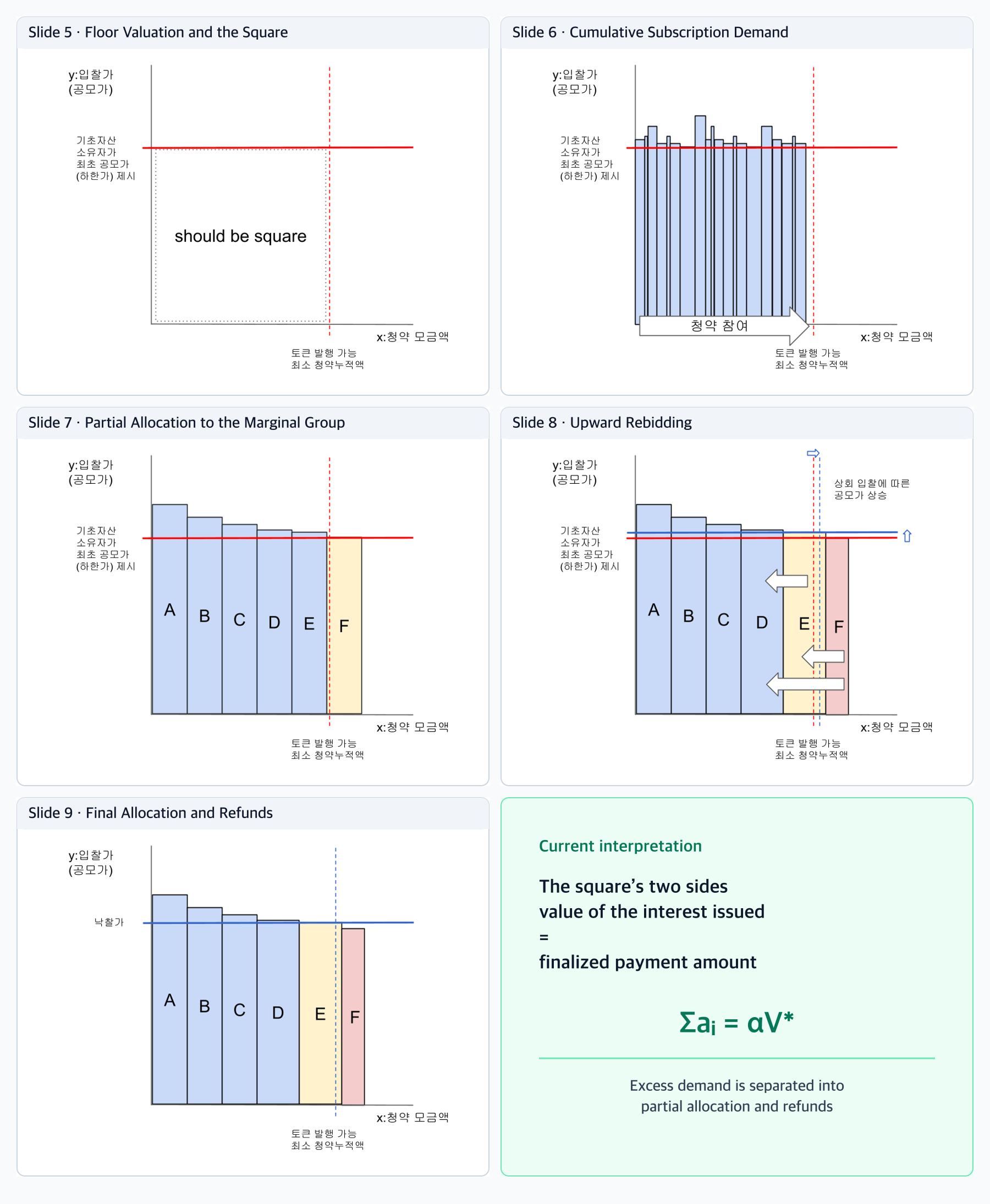
Diagrams cropped and rearranged from slides 5–9 of the original 2023 Polsto fractional-auction design deck, which was written in Korean.
The sequence can also be read in words.
| Slide | The point of the diagram |
|---|---|
| 5 · Floor | Establish the owner's minimum acceptable valuation and the subscription funds needed to match it. |
| 6 · Accumulation | Bids with different valuations and budgets add funds to the auction. |
| 7 · Partial allocation | Take only the required portion of the group at the funding boundary. |
| 8 · Upward rebidding | Higher bid valuations can change the clearing valuation and expected allocations. |
| 9 · Settlement | Finalize payments, allocations, and refunds from the closing result. |
A–F in the historical slides are not the same order data as A–F in the worked example above. The old diagrams show bids changing over time; the new example describes one closed set of bids. In the execution model used here, allocations calculated before closing are provisional. Upward rebidding can change them, but actual allocations, payments, and refunds are finalized after closing.
The following graph restates the square intuition using the worked example. Both axes use the same scale in KRW millions. Because the entire asset is issued, the issuance fraction is 1, and total asset value equals the value of the interest being issued.

At a clearing valuation of 90, valid cumulative demand is 100 but finalized payment is 90. E pays 10 and receives a refund of 10. Separately, all 30 from F is refunded, bringing total refunds to 40. All values are in KRW millions.
At a vertical-axis value of 90, the right end of the demand step is 100. Only 90 is needed, so allocation stops at 90 on the horizontal axis. From the origin to that point, the square has sides of 90. The green segment marks the 10 allocated to E; the gray segment marks the 10 refunded to E.
The square's horizontal side is therefore the sum actually paid after partial allocation, not all valid demand. If the vertical axis instead showed the price per token, its unit would differ and this comparison of lengths would not hold. For a partial issuance, the vertical axis must show the value of the interest issued rather than total asset value to preserve the square.
Turning the Numbers into General Rules
We can now express the calculation with symbols so that it applies to other bids. Amounts use one currency, total token quantity satisfies , and the issuance fraction satisfies . Bid valuations and the floor are positive; budgets are nonnegative. Each token represents the same proportional rights. The equations describe continuous quantities before rounding and exclude fees and taxes.
| Symbol | Meaning and unit |
|---|---|
| Tokens representing the entire asset · tokens | |
| Fraction being issued · ratio | |
| Bidder 's maximum acceptable total valuation · KRW | |
| Bidder 's maximum subscription budget · KRW |
Issuing everything means ; issuing 30% means . The quantity issued is , distinct from the total token quantity .
At Which Total Valuation Is Funding Sufficient?
Let be the sum of budgets from bids accepting a total asset valuation of at least .
The funds eligible at that valuation must cover the value of the interest being issued.
Choose the clearing valuation as the highest value at or above the floor that satisfies this condition. If funds are insufficient even at the floor, the auction does not clear and all funds are refunded. In the main example, , while required proceeds are 90, with values in KRW millions.
The clearing valuation does not have to be one of the submitted bid valuations. For a separate small example, suppose the whole asset is issued, the floor is KRW 80 million, and there are only two bids.
| Bid | Maximum valuation | Budget |
|---|---|---|
| 1 | KRW 120 million | KRW 90 million |
| 2 | KRW 80 million | KRW 30 million |
At KRW 90 million, bid 1 alone exactly covers the required proceeds. The clearing valuation is therefore KRW 90 million, although nobody submitted that valuation. Bid 1 is accepted in full with no partial allocation, and bid 2 is fully refunded. Conversely, if the only bid has a maximum valuation of KRW 120 million and a budget of KRW 70 million, a floor of KRW 80 million cannot be met.
More generally, when lies in an interval that does not coincide with a submitted valuation, and all valid bids can be accepted in full. That interval may lie between submitted valuations or below every submitted valuation.
How Much Is Taken from the Marginal Group?
If demand jumps at a group that submitted exactly , accept higher-valued bids in full and take only the remaining amount from that marginal group. Let be the sum of budgets from higher bids and the sum from the marginal group.
Required proceeds lie between and . For a marginal group with , its allocation rate is:
This is “the amount still needed after higher bids are accepted, divided by the marginal group's budget.” In the main example, , so E pays half its budget. The issuance fraction and the marginal allocation rate are different ratios.
Calculating Tokens and Refunds from Payments
Bidder 's actual payment is for higher bids, for marginal bids, and 0 for lower bids. The unit issue price , token allocation , and refund are:
The unit price divides total asset value by the total token quantity. A partial issuance does not change the denominator to the issued quantity . Actual payments buy tokens at that unit price; unused budgets are returned.
Before rounding, the following bounds and totals must hold.
The square represents the equality : total finalized payments equal the value of the interest issued. Raw cumulative demand may still contain marginal funds that will be refunded.
An implementation must fix price increments, currency units, and minimum token units, then record rounding remainders separately. Its rules must also determine the order for allocating the final token units and refunding small residual amounts.
What Existing Auctions Contributed
Google's 2004 IPO auction was a reference for the original design. Its clearing price was calculated as the highest price that could sell all offered shares, but Google and the underwriters could choose a lower final offering price or reject manipulative bids. The prospectus also discussed the winner's curse and post-listing price declines. Google's 2004 SEC prospectus shows both auction-based price discovery and its limits.
The single-price auction for U.S. Treasury securities also offers a reference for uniform pricing and pro rata allocation at the boundary. Competitive Treasury bidders, however, submit desired amounts and rates or yields against a fixed offering amount. This article's model instead uses total asset valuations and budgets, with different inputs and clearing conditions. Similar allocation principles do not make the auctions identical.
What a Uniform Price Does—and Does Not—Provide
The uniform issue price per token, , has several benefits that are easy to explain.
- It does not apply a different price to each successful bidder.
- The marginal bid valuation and partial-allocation rule can be disclosed in advance.
- The finalized payment, token allocation, and refund can be verified as one result.
- Compared with discriminatory pricing based on each bidder's submitted valuation, it can reduce the pressure to guess the exact clearing valuation.
But a uniform price does not by itself produce fair value or truthful bidding.
A large bidder seeking multiple units may use a demand reduction strategy, submitting less demand because the bidder
considers the effect of its own order on the clearing valuation. Conversely, if the bid valuation determines allocation
priority while actual payment occurs at a lower uniform issue price corresponding to the clearing valuation, a bidder
who believes it is unlikely to set the clearing valuation may submit an excessively high simply to secure priority.
The possibility of demand reduction and efficiency losses in single-price, multi-unit auctions is analyzed in
research by Ausubel and Cramton.
That does not mean the findings apply unchanged to the valuation and budget model in this article, but they expose an
attack surface that requires strategic demand submission to be evaluated separately whenever multiple units are
allocated at the same price.
The winner's curse also remains when the underlying asset is real estate, art, or copyright—assets for which participants assess the same subject using different information. The investor willing to accept the highest valuation may be the most optimistic, not the most accurate. Bidding does not replace appraisal, cash-flow analysis, review of the rights structure, or risk disclosure. In its 2022 action concerning Musicow, Korea's Securities and Futures Commission also treated the basis for setting the issuance-auction price as material information for investment decisions and pointed out that the related disclosure had been insufficient.
The fractional auction can therefore produce not fair value, but one clearing valuation and one uniform issue
price formed under a defined set of bidding rules. How closely those values track the underlying asset's long-term
value or the post-issuance secondary-market price is a separate question for validation.
Is Upward Rebidding a Price Signal or a Race for Priority?
The original document allowed bidders to raise their bid valuation during the auction and to increase their subscription amount at the same bid valuation. The idea was that incoming demand could raise the clearing valuation, while an investor who had been only partially allocated or excluded could regain priority.
Combining upward rebidding with real-time demand disclosure makes the process closer to an ascending auction, in which participants raise valuations or amounts in response to visible demand, than to a conventional Dutch auction, in which the price declines over time. If bids remain sealed while only increases are permitted, the information structure changes again. A process that lowers the floor and opens a new issuance auction after a failed auction resembles a Dutch auction only in the direction of lowering the price to find demand.
Open upward rebidding requires additional policies.
- How much of other bidders' bid valuations and subscription amounts should be disclosed in real time?
- Can bids only be increased, or may they also be canceled or reduced before closing?
- When must subscription funds actually be reserved or placed in a payable state?
- Should the closing time be extended when a bid arrives immediately before the deadline?
- How will the system prevent one person from splitting bids across accounts to circumvent marginal-group allocation or participation limits?
- How will bids from related parties or the issuer's side be identified and excluded?
- How will the system reduce follow-on bidding driven by visible orders, as well as transaction front-running and ordering competition in a public mempool?
A sealed-bid or commit-reveal structure that hides bids until closing can reduce some information leakage. On the other
hand, a user who misses the commit or reveal stage may see an otherwise valid bid invalidated, and the lifecycle of
fund reservation and refunds becomes more complex. Whatever structure is chosen, putting the bids on a blockchain
does not by itself eliminate the possibility of manipulation.
A Refund Is Settlement, Not a Side Task
The clearing valuation and uniform issue price attract the most attention on an auction screen, but settlement is the harder part of the actual system.
Payments from higher bids, partial payments from the marginal group, refunds of unallocated funds, and full refunds to lower bids must each be processed exactly once. If the issuance conditions are not met, all subscription funds must be returned. Even if the floor is lowered for another attempt, prior bids must not be carried into a new auction without the investor's consent.
The auction as a whole and each bidder's funds need separate states.
| Subject | Meaning of the states |
|---|---|
| Auction | Open → closed → calculated → allocation fixed → settling → complete |
| Each bid's funds | Reserved → payment and refund determined → each processed and reconciled → complete |
| Failed auction | Full refund without allocation → refund reconciliation → closed |
Token issuance or transfer, payment, and refunds are separate jobs within “settling.” The sequence does not instruct the system to deliver tokens first and collect money later. For example, even after E's 1,000 tokens are recorded, E's settlement is not complete until the KRW 10 million payment and KRW 10 million refund are confirmed.
Retries must not cause duplicate issuance or duplicate refunds. Locking, conditional execution, and failure recovery depend on whether tokens and funds can be processed atomically on one ledger or are handled by separate systems. A state in which only one side has completed remains subject to reconciliation and recovery; it is not complete settlement. This article defines those responsibilities without claiming that a particular settlement mechanism has been implemented or verified.
A ledger can help preserve tamper-resistant records of bid times, rule versions, clearing results, and allocation
history. In an institutional system, customers may submit bids through authenticated business accounts instead of
handling personal EOAs and signing procedures directly, while an institution-controlled key-management and signing
system performs token issuance and transfers. This article uses custodial wallet to describe that technical
structure; the term does not determine whether the arrangement legally constitutes a custody business or what license
status applies. Even in this model, the auction engine's business state, the reserved-funds ledger, wallet signatures,
and blockchain transactions must be connected into one auditable flow.
This boundary overlaps with the middleware discussed in the BXB retrospective. The middleware, however, does not decide who receives how much. Auction rules are market-specific business logic; the middleware connects the determined rules so that they are executed consistently across existing systems, wallets, and ledgers.
Issue-Price Auctions and Secondary Markets Must Remain Separate
Fractional investment, tokenized securities, and public offering are not interchangeable terms. Fractional
investment broadly describes the division of rights into smaller interests, while a tokenized security is a security
recorded using distributed-ledger technology under Korea's capital-markets framework. Whether a right is a security
depends on the substance of the contract and business, not its name or whether a token is used.
The Financial Services Commission's Guidelines on Fractional Investment explain that securities regulation, including disclosure obligations, applies to fractional-investment products that constitute securities, and that, depending on the substance of the activities performed, authorization or registration may be required for investment brokerage or other regulated businesses. Tokenized-securities legislation promulgated in 2026 likewise did not create a new asset outside the regulatory perimeter; it accepted distributed ledgers as a new method of recording securities within the existing securities regime. The amended Electronic Securities Act is scheduled to take effect on February 4, 2027.
This article therefore limits the auction to a model for calculating the price and initial allocation at the new-issuance stage. A secondary market, where investors continuously submit and match buy and sell orders after issuance, has a separate market structure and its own licensing and conflict-of-interest questions. The original document noted more trades from bid revisions and increased fee revenue as side effects, but the value of a new-issuance rule cannot be measured by the number of bid revisions. If issuance and secondary trading sit under the same interests, conflicts of interest must be examined before transaction growth.
Price Is a Protocol Too
Tokenization does not set an asset's price automatically. Nor does an auction make investor judgments truthful or guarantee the fair value of the underlying asset.
What mattered in the fractional-auction design was not that a blockchain would calculate the price, but that it tried to treat the rules that create price and allocation as an explicit protocol.
Who submits which values? At what point does a bid become final? Under what conditions does one price emerge? How are tokens divided among investors at the same marginal bid valuation? How are funds returned after a failure or partial allocation? Who can verify the result?
If tokens are issued without answering these questions, price determination remains an internal process of the issuer and platform. Publishing the rules does not automatically create a good market either. Only after small numerical examples, strategic-bidding simulations, boundary values, and failure scenarios have been worked through does it make sense to discuss implementation.
The 2023 fractional-auction document was less a finished answer than a design note that started that review. Rewriting the square from the original diagram as cumulative demand and a clearing condition made the conclusion simpler.
An issue price is not just a number displayed on a screen. It is a business protocol that binds bidding, allocation, payment, and refunds together.
This article is a technical exploration of a past prototype design, not legal, accounting, or appraisal advice or an investment solicitation. Any real implementation requires separate review of the type of security involved, the distinction between public and private offerings, issuance and brokerage entities, valuation, disclosure, subscription and allocation procedures, and the laws and guidelines in force at the time.